
Cocker Spaniels in Liverpool: a guide
This page is general information for owners. It is not veterinary advice. If you're worried about your dog's health, speak to your vet.
Got a Cocker Spaniel, or thinking of getting one? Here's what trusted sources say about the "merry cocker", along with some friendly tips for life with one in Liverpool.
At a glance
- What they are: a gundog from the Spaniel group, named after the woodcock it was used to hunt. The Royal Kennel Club says the breed wasn't recognised as a separate variety until 1893, and that its ever-wagging tail earned it the nickname "the merry cocker" (Royal Kennel Club).
- Working or show: Cockers come from working lines, show lines or a mix. Battersea says working Cockers tend to be higher energy with shorter coats, while show Cockers are often more laid-back, with longer coats that need more grooming (Battersea). It's worth knowing which line a puppy comes from (Battersea).
- Size: the breed standard gives a height of approximately 39 to 41cm for dogs and 38 to 39cm for bitches, and a weight of approximately 13 to 14.5kg. It's a guide, and an individual dog may be larger or smaller (Royal Kennel Club breed standard).
- Lifespan: over 10 years (Royal Kennel Club).
- Exercise: sources differ slightly. The Royal Kennel Club lists up to 1 hour a day (Royal Kennel Club), while PDSA says a minimum of an hour a day, spread across a few walks with plenty of sniffing, plus off-lead running in a secure area (PDSA). Battersea says around an hour a day plus mental stimulation, and that working Cockers have even higher energy (Battersea).
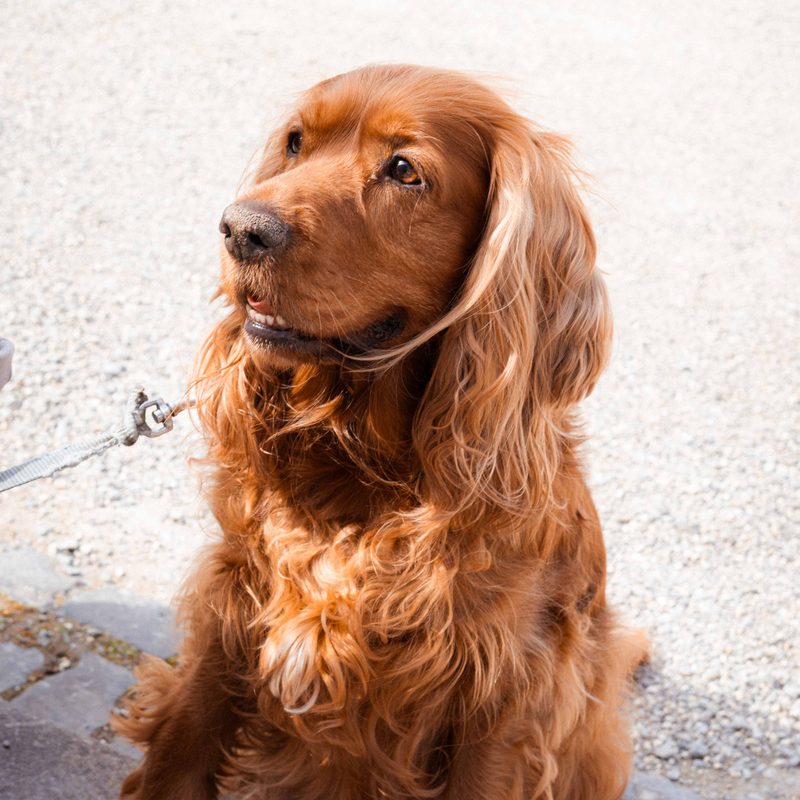
- Coat: flat and silky with feathering on the legs and body (Royal Kennel Club breed standard). Battersea says it needs regular brushing to prevent matting, and grass seeds and burrs easily get caught in it (Battersea).
- Health: Battersea says Cockers can inherit eye conditions such as glaucoma and progressive retinal atrophy (PRA), can develop hip dysplasia and kneecap problems (patella luxation), and commonly get itchy skin and ear infections, often linked to allergies. They can also be more prone to immune-mediated conditions (Battersea). The Royal Kennel Club recommends breeders use DNA tests for acral mutilation syndrome (AMS) and prcd-PRA as a minimum, with further tests and hip and eye screening as best practice (Royal Kennel Club). Choose a breeder who health-tests both parents (Battersea), and speak to your vet about any concerns.
Personality
Every dog is an individual, so treat this as a guide to what Cocker Spaniels are typically like, not a promise. The RSPCA says every Cocker has its own personality, formed as much by environment and upbringing as by its parents (RSPCA).
- Merry and affectionate: the breed standard describes a "merry nature with ever-wagging tail" and a temperament that's "gentle and affectionate, yet full of life and exuberance" (Royal Kennel Club breed standard). Battersea calls Cockers affectionate and playful dogs who like to be on the go, and says many keep their "puppy" energy all their lives (Battersea).
- Clever and keen to learn: PDSA says they're intelligent, with a real willingness to learn, and recommends positive, reward-based training from an early age, kept consistent throughout life (PDSA). The RSPCA notes that, despite their reputation for being easy to train, every puppy learns at its own pace (RSPCA).
- Can find it hard to switch off: Battersea says long walks alone often aren't enough to tire their brain out, and without scent work, retrieving games or puzzle toys they can struggle to settle, which can lead to destructive behaviour. Working and show lines can both have difficulty with recall, barking and resource guarding (Battersea).
- With children: PDSA says Cockers tend to get along well with children because of their patient personalities, but advises always supervising them together and keeping playtime calm, as they can get excitable (PDSA). Dogs Trust adds that any claim that a breed is "good with children" should be treated with caution, because it depends on the individual dog. It also advises that children and dogs should always be closely supervised by an adult, and that your dog needs a den where they can rest undisturbed (Dogs Trust).
- With other dogs: PDSA says Cockers are very sociable by nature, and that if they've been well socialised from a young age they'll usually get on with other dogs and even enjoy their company (PDSA). Dogs Trust points out that some dogs like meeting other dogs and some don't (Dogs Trust).
- When left alone: PDSA says Cockers are known for suffering with separation anxiety, should never be left for more than four hours, and may struggle even with that. It advises teaching them from a young age that short spells alone are OK (PDSA). Battersea adds that teaching them to settle and meeting their exercise needs can help (Battersea). PDSA recommends building up time alone gradually from puppyhood and leaving puzzle toys to keep them busy. It also says four hours is the longest any dog should routinely be left (PDSA). If you work long days, a walker or licensed day care can help. If your dog seems distressed when left, speak to your vet first.
What Cocker Spaniels love doing
Cockers usually need a job for their brain as well as their legs. Battersea suggests scent work, retrieval games and puzzle toys alongside walks (Battersea). Here are some ideas.
(Ad) Product links in this section are Amazon affiliate links. We may earn a small commission if you buy, at no extra cost to you. How this works
Sniffing and search games
The breed standard describes the Cocker's bustling movement "particularly when following scent" (Royal Kennel Club breed standard). Battersea says Cockers enjoy search games and scent work (Battersea). Tip: hide a toy or a few treats around the house or garden, and let them have a good sniff on walks. It's brain work for them.
In Liverpool: Precious Paws (L24) runs owner workshops that include scent work (Precious Paws, checked 18 Oct 2026).
Try at home (Ad):
- Petface Fabric Snuffle Ball (Ad) View on Amazon
Fetch and retrieving games
PDSA says that, as gundogs, Cockers are particularly good at retrieving (PDSA), and Battersea recommends retrieval games to tire out their brains (Battersea). Tip: add a "wait" before you throw so they have to think as well as run. Find space on our dog walks and parks page.
In Liverpool: council parks in our listings with plenty of room include Sefton Park (L17), Croxteth Country Park (L11), Walton Hall Park (L4) and Newsham Park (L6). Dogs aren't allowed in play areas, walled gardens, picnic areas or on sports pitches (council guidance).
Try at home (Ad):
- Dog & Field 1/2lb Training Dummy (Ad) View on Amazon
Off-lead running
PDSA says Cockers need off-lead exercise in a secure area to run off their energy (PDSA). Because recall can be tricky for the breed (Battersea), practise it in an enclosed space first. Tip: our walks and parks page lists places to stretch their legs. Check the signs for lead rules.
In Liverpool: green spaces in our listings include Childwall Woods (L16), Woolton Woods & Camp Hill (L25), Croxteth Country Park (L11) and Stanley Park (L4). Dogs aren't allowed in play areas, walled gardens, picnic areas or on sports pitches (council guidance).
Try at home (Ad):
- JKG 10m Long Line Recall Lead (Ad) View on Amazon
Puzzle feeders and food games
Battersea lists puzzle toys as one way to meet a Cocker's need for mental stimulation (Battersea). PDSA recommends enrichment feeders such as Kong-style toys to keep dogs busy when they're left (PDSA). Tip: make sure any toy you leave them alone with is safe and can't be chewed up and swallowed.
Try at home (Ad):
- Nina Ottosson Dog Puzzle Toy, Level 2 (Ad) View on Amazon
Agility and training classes
PDSA says Cockers are quick and agile, so tend to do well at agility (PDSA), and Battersea says they thrive on training and activities like agility (Battersea). The Royal Kennel Club recommends dogs don't start training on agility equipment until they're at least a year old (Royal Kennel Club). Tip: PDSA suggests training classes if you're a first-time owner (PDSA). Find one on our Liverpool dog trainers page.
In Liverpool: Precious Paws (L24) runs a four-week Agility & Hoopers Foundation course for puppies under one year (Precious Paws, checked 18 Oct 2026). Wag n' Waves (L24) runs reward-based puppy and adolescent classes and one-to-one sessions (Wag n' Waves, checked 18 Oct 2026).
Try at home (Ad):
- Trixie Agility Basic Tunnel, 5m (Ad) View on Amazon
- Coachi Multi-Clicker (Ad) View on Amazon
Playing with other dogs
A well-socialised Cocker will often enjoy spending time with other dogs (PDSA). Tip: if your Cocker loves company, a licensed day care can keep them busy while you're at work. Our walks and parks page has spots to meet other dogs.
In Liverpool: Wag n' Waves (L24) runs small weekly dog socials, grouped by size, with a maximum of five dogs. Each one starts with a group walk (Wag n' Waves, checked 18 Oct 2026). For puppies, Precious Paws (L24) runs a Sunday puppy playgroup for socialisation (Precious Paws, checked 18 Oct 2026).
Try at home (Ad):
- Rosewood Battersea Rope and Rubber Tug, Large (Ad) View on Amazon
Living with a Cocker Spaniel in Liverpool
Keep that busy brain busy. Mix walks with sniffing games, retrieving and puzzle toys (Battersea). Our dog walks and parks page has ideas for places to go. Always check the signs for lead rules and any areas where dogs aren't allowed.
Brush daily and book regular grooms. PDSA says Cockers are high maintenance: they need a daily brush to stop tangles, a quick brush after walks to check nothing's stuck in their fur, and possibly a professional clip every three months or so, especially show types. Working types usually need fewer grooming visits (PDSA). Battersea suggests getting puppies used to grooming and handling early (Battersea). PDSA's general advice is not to tackle matts at home and to choose a reputable groomer (PDSA). Find one on our Liverpool dog groomers page.
Check those ears. Ear infections are common in Cockers, and some find ear handling hard, so getting them used to it early helps (Battersea). If you see wax, smell or itching, call your vet before cleaning (PDSA).
Muddy walks happen. If they just get muddy, PDSA suggests rinsing them in warm water rather than reaching for the shampoo (PDSA).
Start training early. Look for reward-based classes on our Liverpool dog trainers page.
Out at work all day? PDSA says it's best to have someone with a Cocker during the day (PDSA). Browse our Liverpool dog day care page, where we show council licence numbers wherever they exist.
Local help
Barkers Liverpool in Garston (L19) lists a Cocker Spaniel groom on its own booking page (checked 18 Oct 2026). See all dog groomers, trainers, day care and vets in Liverpool.
Share your Cocker Spaniel
Got a Liverpool Cocker Spaniel? We'd love to see them! Share your photos with us on Instagram @happydogliverpool.
See all our dog breed guides, A to Z
This page contains affiliate links, marked "View on Amazon" or 🛒. Affiliate disclosure. This guide is general information, not veterinary advice. Always speak to your vet.